
The Verdict Phase: How T20 Cricket Abandoned Caution for a Six-Over Siege
Explore how the 2026 T20 powerplay evolved from a cautious launch to a high-stakes, 6-over assault, featuring analysis of Sooryavanshi, Sharma, and more.
1. Historical Evolution & Tactical Context
The metamorphosis of the T20 powerplay from a period of conservative preservation to a stage of terminal aggression is rooted in a fundamental shift in risk-appetite metrics. Between 2016 and 2020, batting lineups operated under the dogma of the 'cautious launch,' prioritizing the sanctity of the wicket to facilitate a later-stage surge. This era was defined by defensive risk-aversion, where the priority was surviving the moving ball to ensure availability for the death overs. However, the maturation of T20 analytics has rendered this logic obsolete, as data confirmed that the marginal utility of a wicket in the powerplay is significantly lower than the value of run-rate maximization.
Technological advancement served as the catalyst for this tactical pivot. The introduction of high-swell, low-mass English willow allowed for accelerated bat speeds, effectively narrowing the gap between a 'safe' defensive block and an aggressive lift. Concurrently, the 'Impact Player' rule introduced a structural shift in team composition, providing an insurance policy that emboldened opening pairs to operate at near-maximum volatility. With the fear of early collapse mitigated by batting depth extending to the number nine or ten, the powerplay became an unrestricted free-fire zone.
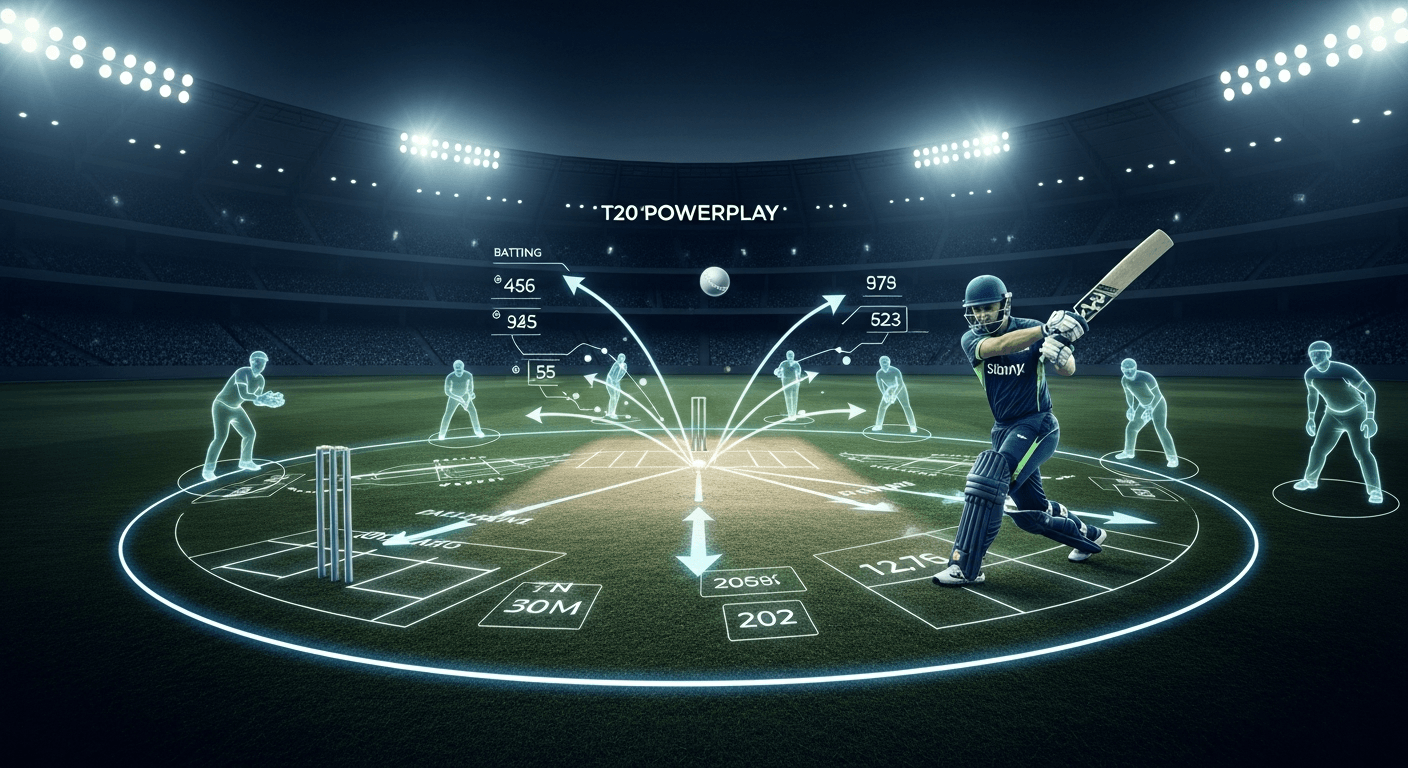
Finally, the 'Geometric Weaponization' of the field has forced captains into a state of permanent defensive reactive, as batters no longer swing purely for the straight or mid-wicket fence. The integration of switch-hitting and refined reverse-ramping, facilitated by tracking software that predicts a bowler’s release point within milliseconds, has neutralized traditional line-and-length bowling. By 2026, the first six overs have been systematically rebranded from a 'setup' phase to a 'verdict' phase, where the game’s trajectory is frequently decided before the field expands.
2. Comprehensive Performance Data Center
To quantify this shift, we look at three primary drivers of the 2026 tactical landscape. Vaibhav Sooryavanshi serves as the archetype for this shift; his 2026 IPL performance, yielding 490 runs in powerplay phases, operated at a strike rate of 212.0. His shot involvement percentage—the ratio of intentional attacks to defensive leaves—reached an staggering 72%, signaling a move away from 'pitch evaluation' entirely.
Compare this to Abhishek Sharma, whose 2026 data indicates a Boundary Efficiency of 8.4 balls per boundary, far eclipsing the historical 11.6 benchmark. Sharma’s approach is predicated on identifying seam-position errors within the first two deliveries of an opening spell. Similarly, Finn Allen demonstrates a distinct 'No-Fear' profile, frequently facing top-tier international seamers in the 140kph+ bracket, yet maintaining an Impact Score—runs added above expectation—of +14.2 across the first three overs of his appearances. These players utilize a 'pre-meditated destruction' model that ignores the reputation of the bowler, focusing instead on the geometry of the available gaps.
3. Biomechanical & Technical Execution
The physical execution of the 2026 powerplay relies on a hyper-efficient kinetic chain. Elite batters like Phil Salt and Abhishek Sharma employ a narrowed base at the point of delivery, allowing for rapid weight transfer. Unlike the stable, centered stances of the 2010s, modern players utilize a 'dynamic trigger,' where the front foot movement is less about forward momentum and more about adjusting the head position to track the release point. This stability allows for the 'high back-lift' technique, which creates a wider arc for the bat to accelerate through, maximizing sweet-spot contact on deliveries that would historically result in edges.
Wrist-dominance has also replaced shoulder-driven power. By keeping the hands close to the body and unleashing the wrists at the moment of impact, these athletes can manipulate the ball’s trajectory across 360 degrees. This biomechanical mastery enables the execution of '3D hitting'—clearing the rope while fielders are within the circle—making defensive bowling lengths like the back-of-a-length delivery ineffective, as batters now possess the reach to convert them into cross-batted hook shots or pull-punches.
4. Strategic Trajectory & Future Impact
The 2026 powerplay evolution is permanently altering franchise recruiting and tactical architecture. With the 'middle-over squeeze' effectively neutralized by the dominance of the first six overs, drafting priority has shifted toward 'high-ceiling' openers who can maximize the powerplay regardless of the pitch condition. Teams are moving away from traditional anchors and toward a lineup of specialists capable of operating at 180+ strike rates across all phases.
Strategically, the 'Travishek' blueprint—a dual-aggression opening pair—is now the industry standard. Captains are increasingly forced to burn their premier strike bowlers in the first three overs to stifle the carnage, which creates a 'vacuum' of quality bowling in the middle overs. Future tactical trends will likely see a further rise in 'match-up specialists,' where analysts coordinate specific player roles based on the release-point data of the opposition's depth bowlers, ensuring that the 'verdict' is delivered long before the 15th over.