
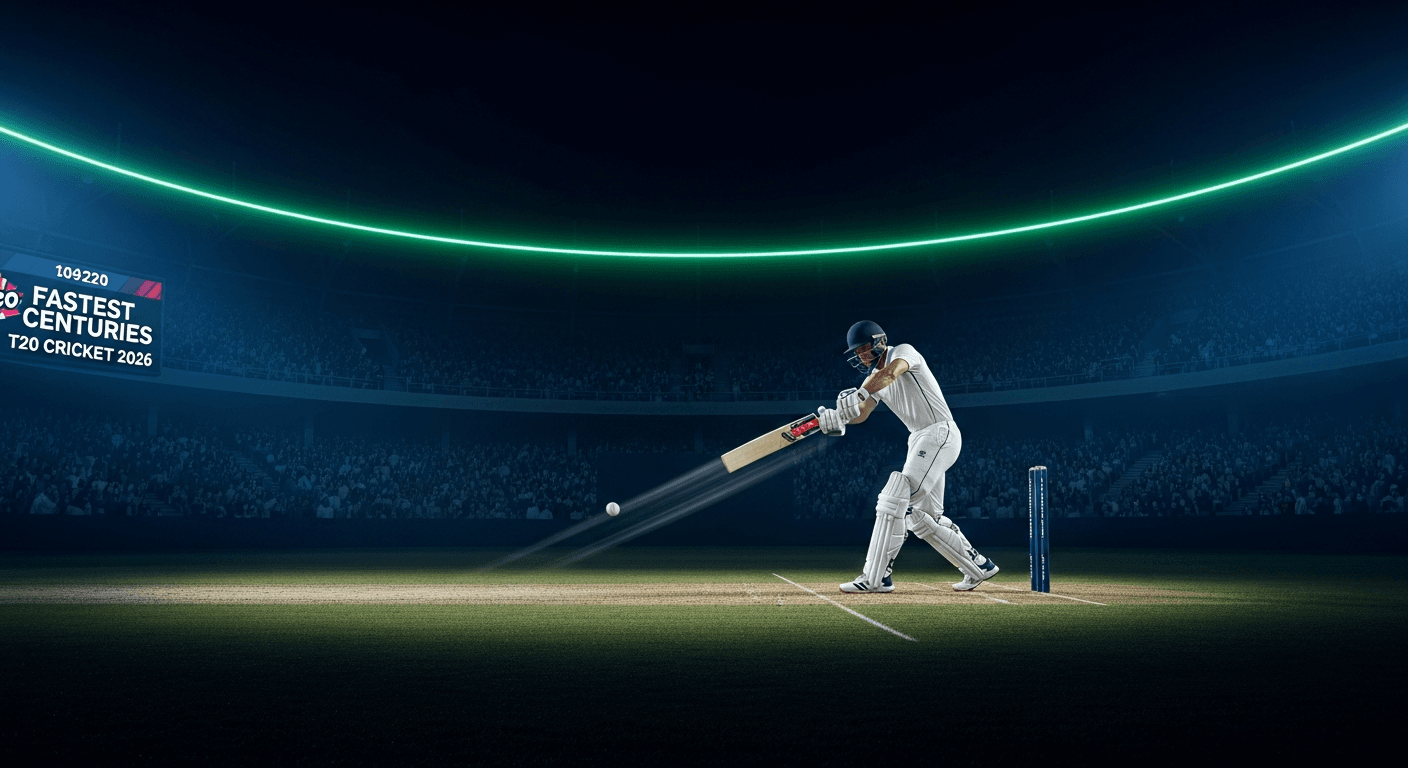
The Evolution of Fastest centuries in T20 Cricket 2026: Analytical Masterclass
Explore our comprehensive analytical breakdown and statistical tracking of Fastest centuries in T20 Cricket 2026.
The 2026 T20 landscape has redefined the boundaries of explosive batting, shifting the paradigm from "calculated accumulation" to "relentless, first-ball intent." As of May 2026, the sport is witnessing an era where power hitting is no longer merely a finishing skill but a foundational requirement for top-order dominance.
The 2026 Data Snapshot: A New Benchmark
The hallmark of the 2026 season—particularly the ICC Men's T20 World Cup—was the surge in centurions. Five centuries were recorded in that single tournament alone, a rare density in a format where elite bowling attacks typically stifle such milestones.
The undisputed statistical highlight of 2026 was ****Finn Allen’s masterclass in the T20 World Cup semi-final against South Africa. His 33-ball century not only secured his place in history but shattered the previous World Cup record (47 balls) held by Chris Gayle for a decade.
Top 2026 T20 World Cup Centuries
| Player | Balls | Opponent | | :--- | :--- | :--- | | Finn Allen (NZ) | 33 | South Africa | | Pathum Nissanka (SL) | 52 | Australia | | Harry Brook (ENG) | 51 | Pakistan | | Sahibzada Farhan (PAK) | 58 | Namibia | | Sahibzada Farhan (PAK) | 60 | Sri Lanka |
Note: The absolute record for the fastest T20I century remains held by Estonia's Sahil Chauhan (27 balls vs. Cyprus, 2024).
Tactical Mechanics: The Science of the "Six Machine"
Modern power hitting has evolved through the integration of biomechanics and data-driven shot selection.
- The X-Factor (Kinetic Chain): Elite hitters in 2026 utilize extreme hip-shoulder separation. By rotating the hips away from the ball while keeping the torso coiled, they store elastic energy in the core. This "stretch-shortening cycle" is then released through the shoulders, arms, and wrists, functioning like a whip.
- Lead Elbow Extension: Research confirms that extending the lead elbow through impact increases the swing arc radius, allowing for higher bat speeds and greater control over launch angles.
- Wrist "Uncocking": Similar to baseball mechanics, the delay of wrist adduction until the final millisecond provides a violent burst of speed at the point of impact, turning good shots into "maximums."
- Equipment Optimization: The 2026 generation employs bats with mid-to-high swell profiles, enlarged sweet spots (often 20–30% larger than traditional models), and edge thicknesses pushed to the 40mm limit. These are engineered for "feather-light" pickups, allowing for rapid bat speed even on shorter backswings.
Key Figures Defining the 2026 Era
- Finn Allen (New Zealand): The definitive power-hitter of 2026. His ability to maintain a strike rate exceeding 300 during his record-breaking innings demonstrates the new "Powerplay-as-Verdict" philosophy, where the first six overs are treated as a non-negotiable window for dominance.
- Sahibzada Farhan (Pakistan): Proving that consistency can coexist with aggression, Farhan became the first player to score two centuries in a single T20 World Cup edition. He represents the "anchor-aggressor" hybrid, capable of stabilizing early pressure before accelerating into a boundary-hitting machine.
- Abhishek Sharma (India): Frequently cited as a "new power king," Sharma is lauded for his high bat speed and ability to attack spin and pace with equal ferocity. His data profile shows an elite ability to identify length early and target specific field-setting gaps.
- Julian Wood (Coach): A pioneer of the "Power Hitting Performance System," Wood has been instrumental in teaching cricketers to move away from hand-dominant batting toward torso-driven power, a technique now visible across many modern international squads.
- Pathum Nissanka (Sri Lanka): His 52-ball century against Australia highlighted the tactical evolution of the "chase-hundred," where specialized openers manipulate the game's rhythm to ensure a team remains ahead of the required run rate throughout the innings.
Summary
The 2026 data indicates that the "Fastest Century" is no longer just an outlier event—it is the logical outcome of a strategic shift toward ruthless, early-innings aggression. With batters now trained to treat the pitch as a physics puzzle to be solved through kinetic energy transfer, the threshold for what defines an "unbreakable" record continues to drop toward the 25-ball mark.