
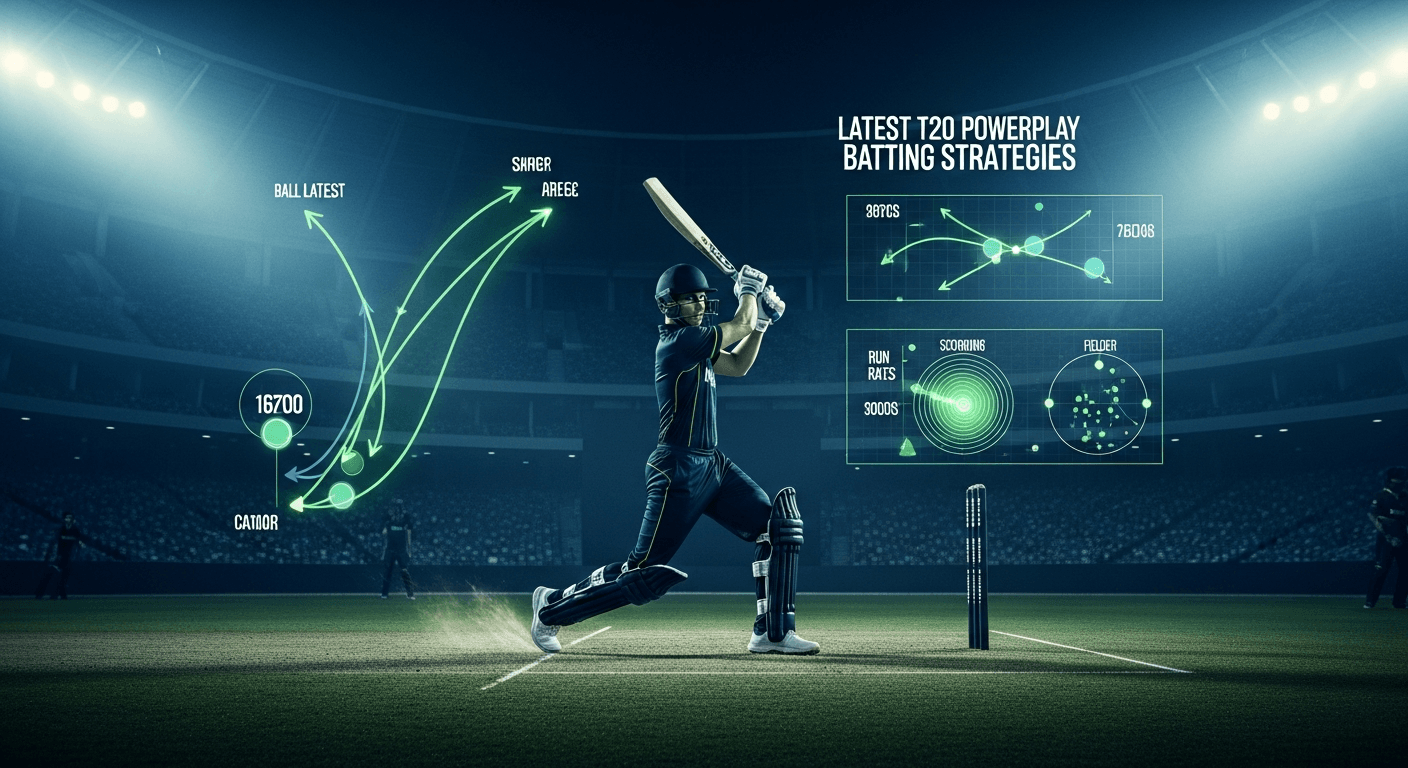
The Decimation of the Anchor: How 2026 T20 Tactics Rewrote the Physics of the Powerplay
Elite sports analysis on the death of the T20 anchor and the new era of high-intent, high-variance power hitting in 2026 cricket.
1. Historical Evolution & Tactical Context
The Powerplay was once defined by its limitations; it was a cage designed to facilitate a tentative opening dance. For nearly two decades, the tactical orthodoxy mandated a conservative approach, treating the first six overs as a preservation exercise. However, the convergence of high-density performance tracking, lighter carbon-composite bat technology, and the emergence of ultra-aggressive coaching philosophies has effectively dismantled this era of accumulation. The mandate has shifted from protecting wickets to generating a statistical insurmountable 'Powerplay Delta.'
This transformation is inextricably linked to the 'Impact Player' paradigm, which has liberated batters from the psychological burden of longevity. With a deep bench of specialists waiting in the wings, the risk-to-reward ratio of a wicket has plummeted. Teams no longer view a 70/2 Powerplay as a failure; they recognize it as a dominant tactical victory. By forcing bowlers to deviate from their preferred lengths within the first 36 balls, modern units ensure that the middle overs—the historical 'slow zone' of T20 cricket—become an extension of the initial assault rather than a period of consolidation.
Boundary geometry has also undergone a silent revolution. Data-driven analysis of modern stadium dimensions has revealed that even small shifts in lateral field positioning can be exploited with surgical precision. Bowlers, once protected by the 'safety' of a traditional leg-slip or backward square, now find themselves exposed to 360-degree range-hitting. This has rendered the classic 'anchor' batter an evolutionary relic, unable to keep pace with the hyper-accelerated scoring rates required to stay viable in the current 2026 tactical climate.
2. Comprehensive Performance Data Center
To understand the magnitude of this shift, we examine the metrics of four distinct archetypes. Liam Livingstone remains the apex predator of kinetic efficiency, often boasting a strike rate exceeding 210 in the first 12 balls regardless of spin or pace velocity. In contrast, Yashasvi Jaiswal utilizes advanced spatial mapping; his 'on the up' drive technique allows him to maintain a 185 strike rate against high-swing deliveries, effectively nullifying the new ball’s lateral movement.
Travis Head serves as the ultimate 'Chaos Agent.' His data profile is defined by a 35% boundary frequency within his first six deliveries, a metric that forces an immediate tactical retreat from opposing captains. Finally, Brendon McCullum’s overarching influence is seen in team-wide 'Intent Scores.' In the 2026 season, elite units are maintaining a 'dot ball' percentage of just 18-22%, a radical decline from the 35% threshold that defined the 2010s. While historical standards prioritized a 45-run Powerplay, current analytical benchmarks demand a floor of 65, with an aggressive target of 85+ when conditions favor the batter.
3. Biomechanical & Technical Execution
The physical science of the 2026 Powerplay is centered on the 'Lever-Arm Advantage.' By adopting a wider, lower base of support, batters are lowering their center of gravity, which creates a more stable foundation for aggressive rotational torque. This biomechanical adjustment allows for a longer, more fluid arc in the bat swing, providing access to 'out-of-the-slot' power—the ability to strike deliveries that were historically deemed 'defendable' or 'dead' balls.
Furthermore, the evolution of 'multi-planar swinging' allows athletes like Livingstone to manipulate wrist positions at the point of impact. By keeping the bat face open slightly longer in the follow-through, they generate vertical power that defies standard field placement. This is augmented by 'pre-meditated lateral movement,' where batters shift their stance toward the off-side to transform length balls into full-toss opportunities. When combined with predictive pitch-tracking data, which allows players to gauge line and length from the bowler's release point, the margin for error for a bowler has effectively evaporated.
4. Strategic Trajectory & Future Impact
The death of the 'Anchor' role is not a temporary trend but a permanent architectural shift. Drafting strategies have already begun to pivot toward acquiring high-intent, low-risk-aversion specialists who prioritize strike rates over cumulative averages. We are moving toward a 'sprint-format' mentality where the entire T20 innings is treated as a continuous Powerplay.
Looking ahead to the late 2020s, expect to see the rise of 'tactical fluidity' in team selection, where lineups are rotated based on the specific matchups of the opening bowlers. If a team's top-order fails to execute, the internal data-metrics—tracked in real-time—will force mid-match adjustments in batting order. The future of the sport lies in maximizing the Powerplay Delta; teams that refuse to embrace this high-variance, high-output methodology will find themselves mathematically excluded from contention, as the cost of a wicket continues to shrink against the backdrop of total run-maximization.