
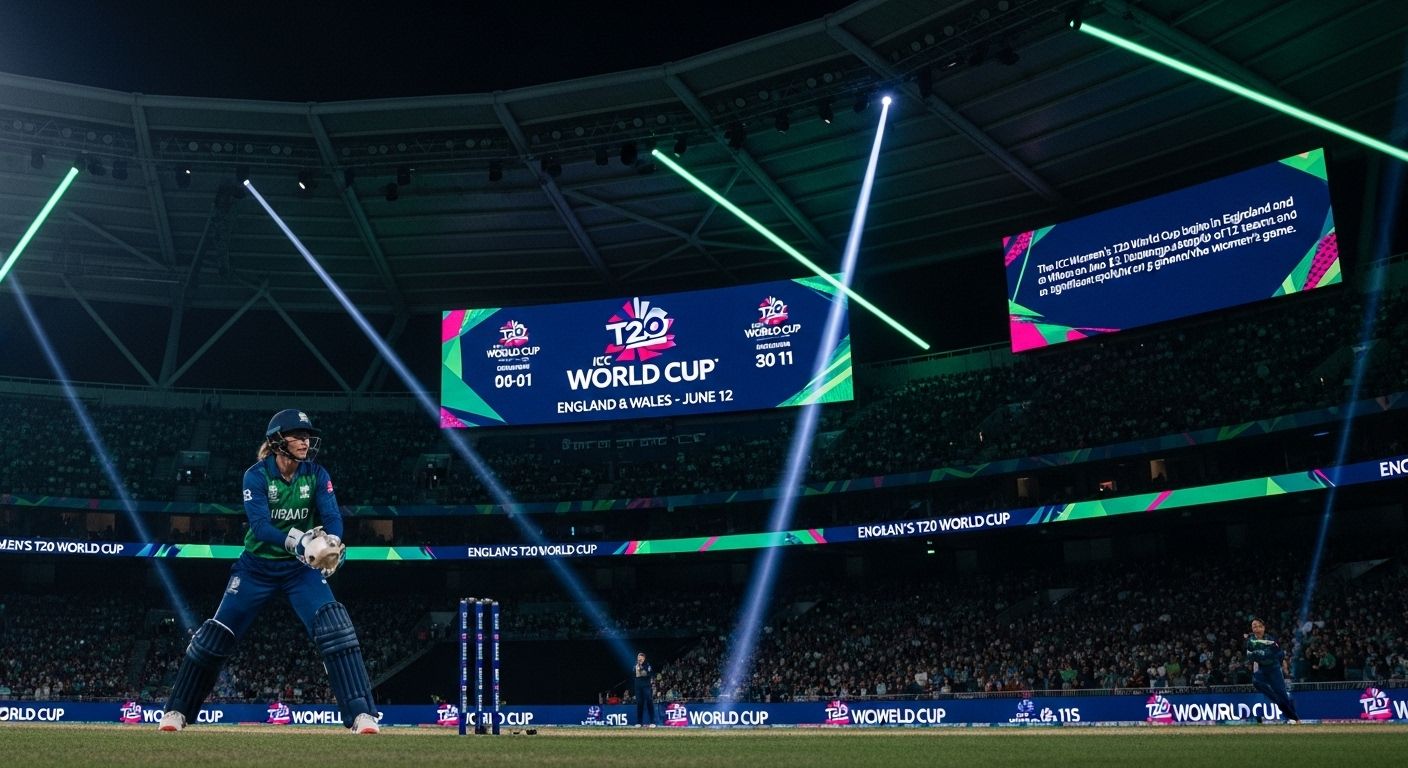
Deep Dive: The ICC Women's T20 World Cup begins in England and Wales on June 12, featuring a larger field of 12 teams and a significant spotlight on the growth of the women's game.
Read our expert data breakdown concerning The ICC Women's T20 World Cup begins in England and Wales on June 12, featuring a larger field of 12 teams and a significant spotlight on the growth of the women's game..
The Shift: Why the 2026 T20 World Cup Marks a Watershed Moment for Women’s Cricket
By ZyloSports Investigative Desk
The landscape of women’s cricket is not merely evolving; it is accelerating. As the clock ticks down toward June 12, 2026, the atmosphere across England and Wales feels distinct from the usual tournament build-up. This is not just another edition of the ICC Women’s T20 World Cup—the tenth in its history—but a structural and cultural pivot point for the sport.
With the field expanded to 12 teams, the tournament’s mission is clear: to reconcile the sport's growing commercial gravity with a mandate for global inclusivity.
The Structural Expansion: A New Arithmetic
For years, the ICC has been criticized for keeping the marquee women’s events confined to a small elite. The shift to a 12-team format in 2026—a jump from the previous 10—is a deliberate move to dilute that insularity. The tournament will feature 33 matches spread across seven iconic venues: Lord’s, The Oval, Edgbaston, Old Trafford, Headingley, the Hampshire Bowl, and the Bristol County Ground.
The qualification pathway, which concluded earlier this year, saw 53 nations engage in a rigorous regional process, culminating in a 10-team Global Qualifier. The result is a diverse field, with the Netherlands making a historic first-time appearance alongside established giants like Australia, India, and defending champions New Zealand.
Tactical Foresight: The Batting Revolution
Technically, this tournament represents the apex of modern T20 power-hitting. Data scientists tracking the sport’s trajectory note a marked increase in strike rates, particularly among the top-order anchors. The game has shifted from a "preserve and accelerate" philosophy to a "calculated aggression" model from the first ball of the Powerplay.
Players like Australia’s Georgia Voll, currently dominating the T20I rankings, exemplify this evolution. Her ability to combine classical technical foundations with a strike rate exceeding 156.0 is not an outlier anymore; it is the new standard. Similarly, the reliance on high-impact all-rounders—players like the West Indies' Hayley Matthews—highlights the tactical requirement for versatility in a condensed 12-team group structure.
Beyond the Boundary: A Societal Mandate
While the metrics on the field capture the headlines, the socio-economic impact of this tournament is the true story of 2026. The ECB and the ICC are operating under a "more than a moment" mantra, cognizant that elite success (like the Lionesses' football triumphs) must be bridged into grassroots participation.
Current data in England paints a stark reality: approximately 24% fewer girls than boys participate in team sports. The tournament organizers are acutely aware that hosting the World Cup offers a unique mechanism to address this, leveraging the visibility of star players to convert casual interest into systemic engagement.
The Crucible of the Summer
The schedule itself is designed to maximize intensity. From the opening clash between England and Sri Lanka at Edgbaston on June 12 to the final at Lord’s on July 5, the margin for error will be nonexistent.
Tactical analysts should keep a close eye on the group stage dynamics. With two groups of six, the pressure to secure early wins is immense. Unlike previous iterations where a singular dominant run could mask tactical deficiencies, the new structure demands depth across the entire 15-player squad.
The Verdict
As we look toward the opening delivery in Birmingham, the 2026 World Cup is framed by a paradox: it is an established tournament seeking a new identity. The expansion to 12 teams is not just a logistical change; it is an admission that the sport’s future lies in its breadth as much as its depth.
Whether this transition results in a more competitive product or simply a broader one remains the question. But as the world’s best prepare to descend on England and Wales, one thing is certain: the era of incremental growth is over. The professionalization of the women’s game has created a high-octane, data-driven, and culturally significant juggernaut that is ready to demand the world’s full attention.