
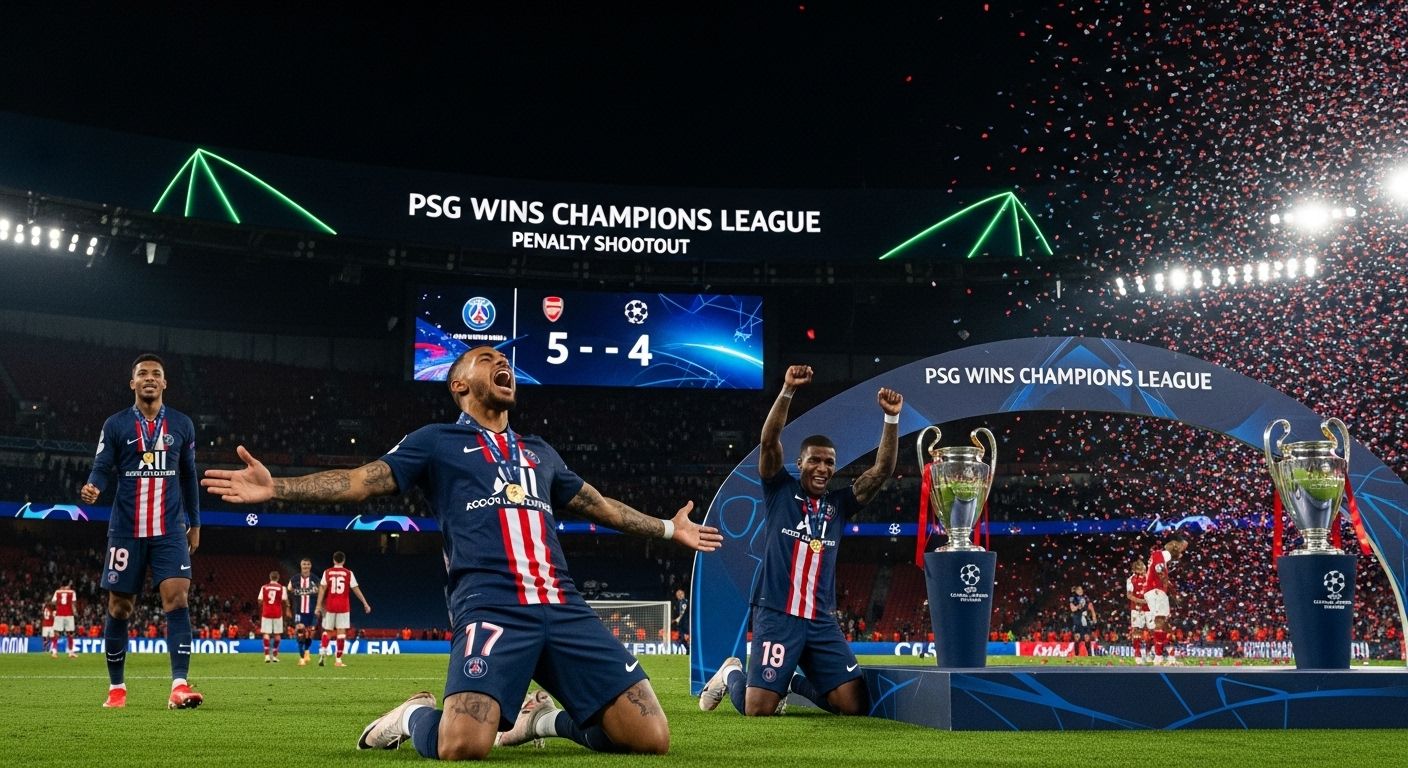
Deep Dive: Paris Saint-Germain secures back-to-back UEFA Champions League titles after a dramatic penalty shootout victory over Arsenal in the final
Read our expert data breakdown concerning Paris Saint-Germain secures back-to-back UEFA Champions League titles after a dramatic penalty shootout victory over Arsenal in the final.
The Parisian Dynasty: How PSG Stamped Their Authority on European Football
By ZyloSports Investigative Desk May 31, 2026
BUDAPEST — The Puskás Aréna, a cauldron of noise under the Hungarian night sky, bore witness to the birth of a dynasty. As the final penalty from Arsenal’s Gabriel Magalhães soared into the night, mirroring the trajectory of a season defined by relentless, high-stakes attrition, Paris Saint-Germain did not just win another trophy. They solidified their metamorphosis from European football’s glamorous underachievers into its most cold-blooded, resilient force.
With a 4–3 victory on penalties following a taut 1–1 draw, Luis Enrique’s side successfully defended their UEFA Champions League crown. They are the first club since Zinedine Zidane’s Real Madrid (2016–2018) to retain the trophy in the modern era, and the first French side in history to achieve back-to-back continental supremacy.
The Tactical Chess Match
For 120 minutes, the final was a masterclass in tactical discipline. Arsenal, fresh off their first Premier League title in 22 years, arrived with a mandate to suffocate the PSG machine. Mikel Arteta’s defensive blueprint was evident within six minutes: a high-press transition that saw Marquinhos’ clearance ricochet off Leandro Trossard into the path of Kai Havertz. The German striker, demonstrating the composure of a man who had been here before, rifled the ball into the roof of the net, marking the second time he has scored in a Champions League final for two different clubs.
For the next hour, Arsenal operated with the clinical, low-block efficiency that has defined their domestic dominance. They effectively doubled up on Khvicha Kvaratskhelia, severing the supply lines that have powered PSG’s record-breaking attack—a campaign that saw the French champions net 45 goals across the tournament, averaging 2.8 per match.
"It’s stronger than last year," Luis Enrique noted post-match, his voice rasping from the touchline fatigue. "We knew the difficulty against a side as organized as Arsenal. It was a battle of attrition."
The Turning Point
The tide shifted in the 65th minute. Ousmane Dembélé, the creative engine of this PSG iteration, forced the breakthrough after drawing a penalty. His calm conversion leveled the score, injecting a sudden, frantic urgency into the match.
The ensuing extra time was an exercise in exhaustion. Both managers, fearing the cruelty of a shootout, pushed for a winner. Arsenal’s Viktor Gyökeres came agonizingly close, denied only by the narrowest of margins, while Bradley Barcola missed a golden opportunity with the final kick of the game that would have spared his side the nerve-wracking reality of penalties.
The Shootout: Nerve and Nuance
As the game moved to the spot, the psychological advantage appeared to lie with Paris. Under Luis Enrique, the Parisians had triumphed in three previous shootouts this season, fostering an air of inevitability.
The shootout began with high-quality spot-kicks, but the pressure eventually fractured the collective nerves of the finalists. Eberechi Eze’s miss for Arsenal was immediately countered by David Raya’s save from Nuno Mendes, leaving the sides locked in a stalemate.
Ultimately, it fell to the fifth kick. With Lucas Beraldo having restored PSG’s advantage, Gabriel stepped up, his composure betraying him as he skied the effort. It was a cruel, anti-climactic end to a European dream for the North Londoners, but for Paris, it was the validation of a radical project.
The Dynasty Question
The narrative of this victory is as significant as the result itself. This is the second consecutive Champions League title for PSG in the post-Kylian Mbappé era. If the skeptics once claimed the club was a collection of individual stars unable to function as a unit, this 2025/26 campaign has dismantled that narrative entirely.
Luis Enrique, now the most decorated manager in the club’s history with 12 trophies, has cultivated a squad that balances attacking flair with the defensive fortitude to survive a slog against the Premier League's elite. With a domestic league title—their fifth consecutive—already in the cabinet, this European triumph cements PSG’s status as a modern powerhouse.
As the smoke cleared at the Puskás Aréna, the reality for the rest of Europe became dauntingly clear: the trophy stays in Paris. The transition from chaotic super-club to a structured, winning dynasty is complete. Whether the rest of the continent can find an answer to the Parisian blueprint remains the defining question of the coming season.